23. Why Change Feels Hard
What’s new: Change fails less because of a lack of discipline and more because of hidden commitments designed to keep us safe.
Why it matters: Once you understand what your psychological immune system is protecting, you can stop fighting yourself and start creating change that actually lasts.
The bottom line: You don’t need to try harder. You need a better map.
You already know what you need to do.
The boundary you need to set. The conversation you need to have. The habit you want to build. The goal you’ve promised yourself you’ll finally pursue.
So why doesn’t it stick?
In this episode of Upleveling Work, Michelle explores why smart, motivated, self-aware people struggle to make lasting change—and why it has far less to do with discipline than we’ve been led to believe.
Drawing on the work of Harvard psychologists Robert Kegan and Lisa Laskow Lahey, Michelle introduces the powerful Immunity to Change framework and explains how our psychological immune systems often protect us from the very changes we most want to make.
You’ll learn:
Why willpower and better plans aren’t enough
The difference between technical problems and adaptive challenges
How your mind protects you from perceived threats to safety, belonging, and identity
The four-column Immunity Map and how to start creating your own
Why the behaviors you’re ashamed of may actually be intelligent acts of self-protection
How the Enneagram offers a window into your hidden assumptions and competing commitments
A practical exercise to uncover what’s really keeping you stuck
If you’ve ever wondered, “Why do I keep ending up here?” this episode offers a more compassionate—and more effective—answer.
Resources Mentioned
Immunity to Change by Robert Kegan and Lisa Laskow Lahey
How the Way We Talk Can Change the Way We Work by Robert Kegan and Lisa Laskow Lahey
Free Immunity Map Sessions
Michelle is offering complimentary 45-minute Immunity Map sessions to the first 20 listeners who reach out. Contact Michelle with the subject line: Immunity Map and include one or two sentences about the change you’re working toward.
Have a favorite podcast player? Here are links to: Apple | Spotify
Transcript
INTRODUCTION
Welcome to Upleveling Work. I'm Michelle Kay Anderson.
This season, we've been digging into what it actually takes to carve out a big, beautiful life on your own terms. We've talked about the gap between where you are and where you know you're capable of being. The people-pleasing patterns that quietly drain you. Getting stuck in the wrong conversation instead of the right one. Growing your capacity without burning it down.
Here's what I notice when I look at all of those episodes together: they're all describing the same thing, from a different angle. A pattern that knows exactly what it wants, reaches for it — and then, somehow, doesn't get there.
Today I want to name that thing directly. Not as another framework to add to the pile, but as the piece that makes every other framework actually usable.
And if it helps to know you're not the only one circling this: researchers once studied people who'd just had a serious medical conversation with their doctor — the kind where the doctor says, "if you don't change, this could kill you." These were motivated, capable, scared-into-action people. One year later, only 13% had made lasting change. McKinsey's research on organizational change puts the failure rate at 70%.
So if this has felt hard for you, you're in very good company.
The question is why? Why do smart, motivated, self-aware people keep running into the same wall? Why does change feel so hard even when we desperately want it?
And more personally: why have you been circling the same thing (the same habit, the same pattern, the same goal) for longer than you'd like to admit?
I don't think the answer is what most of us have been told. And today, I want to give you a completely different way to look at it.
PART ONE: THE DEFAULT MODEL FOR CHANGE (AND WHY IT DOESN'T WORK)
Most of us approach change the same way.
We get frustrated enough (or maybe scared enough, or inspired enough) to make a commitment. We identify what we've been doing wrong. We make a plan. We try harder.
I call this the New Year's resolution model of change. And we all know how it goes:
You feel excited in January. By February, progress is slowing. By April, you can barely remember what you committed to. And somewhere in there, the narrative shifts from "I'm going to change" to "something is wrong with me." Not enough discipline. Not enough willpower. Not brave enough. Not ready enough.
Here's the thing: that narrative isn't just unkind. It's also not accurate.
And trying harder with the same model almost never works, because most of the change we actually want to make isn't a technical problem. It's what researchers call an adaptive challenge.
The distinction comes from Harvard professor Ronald Heifetz, and it's one of the most clarifying frameworks I've ever encountered.
A technical challenge has a known solution. You need the right information, the right skill, the right process. Surgery is a technical challenge - it's complex, but there's a procedure. Follow it correctly and you get the outcome.
An adaptive challenge is different. There's often technical knowledge involved, but it's not sufficient, because the real change required is in your beliefs, your mindset, your sense of who you are. You can't solve it with information alone, because the obstacle isn't a lack of information. It's something operating at a much deeper level.
The single biggest mistake I see people make (and leaders and organizations make) is trying to solve adaptive challenges with technical means. Getting more advice. Reading more books. Taking more courses. Making better plans.
None of that gets at what's actually holding you in place.
So what is?
PART TWO: YOUR PSYCHOLOGICAL IMMUNE SYSTEM
I want to introduce you to a framework developed by Harvard psychologists Robert Kegan and Lisa Laskow Lahey. They spent decades studying why people don't change, and what they found is elegant and, I think, deeply compassionate.
They call it the immunity to change.
The idea is this: your mind, like your body, has an immune system. Its entire purpose is to protect you - to scan for danger, identify threats, and keep you safe.
Your body's immune system does this constantly without your awareness. It fights off bacteria, manages inflammation, protects you from pathogens you'll never know existed. And it does this beautifully, most of the time.
But sometimes, the immune system makes an error. Like when itt rejects a heart transplant - It sees the new heart (the thing that was put there specifically to save your life) as a threat, and it attacks it.
Your psychological immune system can do the same thing.
It scans for danger. It identifies threats to your sense of self, your belonging, your safety. And when it detects a threat, it mobilizes — protecting you from the very changes you need most.
The most important thing to understand is this: when your immune system is running, it isn't malfunctioning. It's doing exactly what it was designed to do. It's trying to keep you safe. The problem is that it may be protecting you from a danger that isn't actually there anymore (or never was).
This is not a character flaw. It's not weakness. It's biology, shaped by lived experience.
PART THREE: MAPPING YOUR IMMUNE SYSTEM
Kegan and Lahey created a process called the immunity map. I think of it as x-ray vision — a way to see the invisible system operating just below the surface of your goals. And it has four columns. (If you go to the show notes at uplevelingwork.com/23, you can see this visually and download a copy to use as a worksheet.)
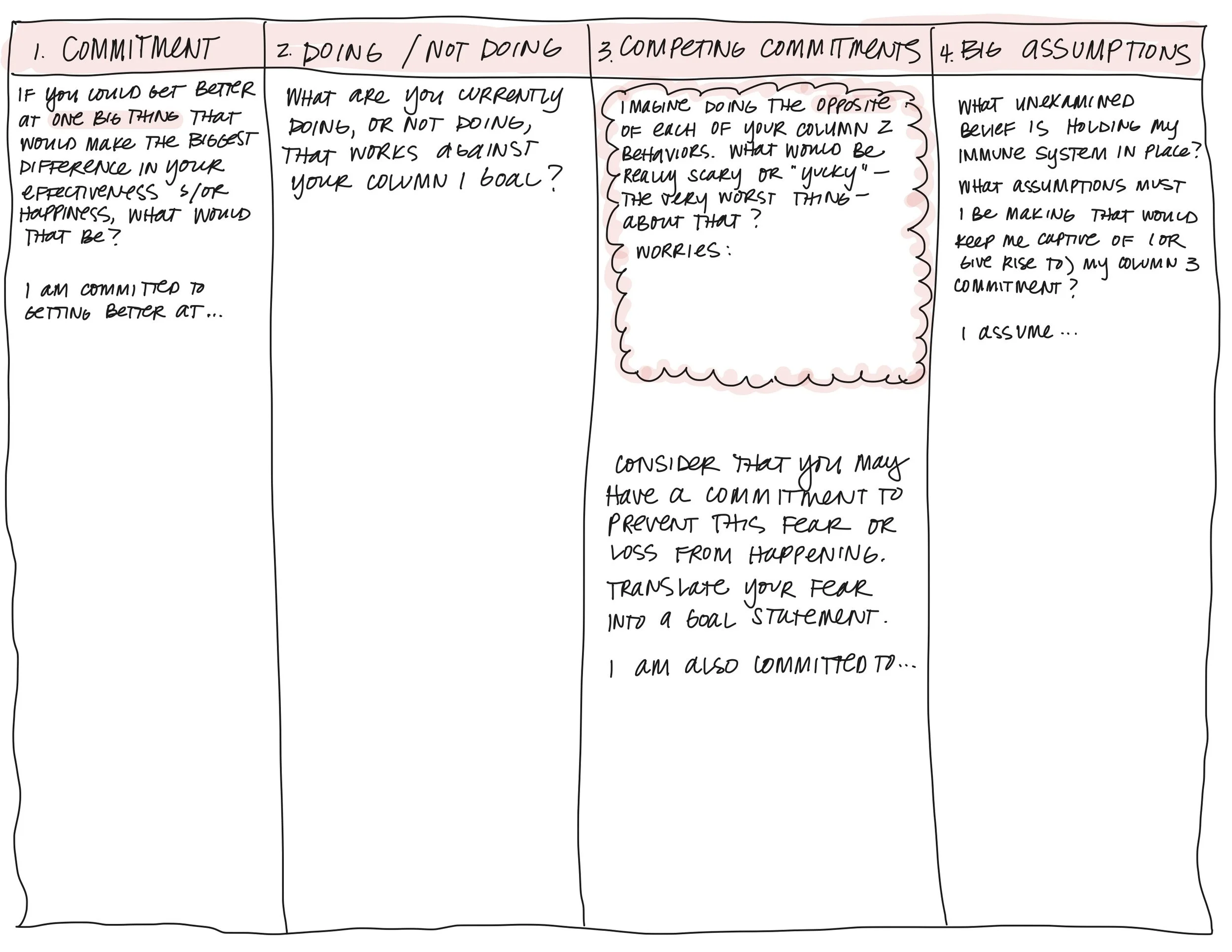
So, I'll walk you through the process I use with my coaching clients. Imagine you have a piece of paper and you fold it into 4 columns, your first column...
Column 1: Your visible commitment. This is what you genuinely want. Not an outcome, but something you want to get better at. I'm committed to getting better at honoring my own needs. I'm committed to getting better at speaking up. I'm committed to getting better at following through on what matters most to me.
Column 2: What you're actually doing. This is where you tell on yourself — honestly and without explanation. Not why you do these things, just what you actually do (or don't do) that works against your commitment. The more honest and concrete, the more useful. This column often brings up shame. That's normal. It's information.
Here's what's important about this column: most of us, when we see our Column 2 list, jump straight to: "Okay. I need to stop doing that. Buckle down. Try harder." That's the New Year's resolution model kicking in. And it rarely works — because Column 2 behaviors aren't random or weak. They're serving a purpose.
Column 3: Your hidden competing commitment. This is the trickiest column, and the most revealing. The question here is: if you imagine actually doing the opposite of what's in Column 2, what comes up? What would be the most uncomfortable, worrisome, or outright terrifying thing about that?
Sit with it. Go past the noble-sounding surface answer. We're looking for the "yuck factor" — an actual felt sense of dread or loss. What would you hate for others to see in you? What would you hate to see in yourself?
Those fears point to a hidden commitment — something you're already working hard to protect yourself from, without knowing it.
A few examples of what this might sound like:
I'm also committed to not being seen as difficult or demanding.
I'm also committed to making sure no one is disappointed in me.
I'm also committed to not finding out I'm not as capable as I think I am.
These aren't aspirations for the future. They're things you're already doing, right now, to make sure the thing you fear doesn't happen.
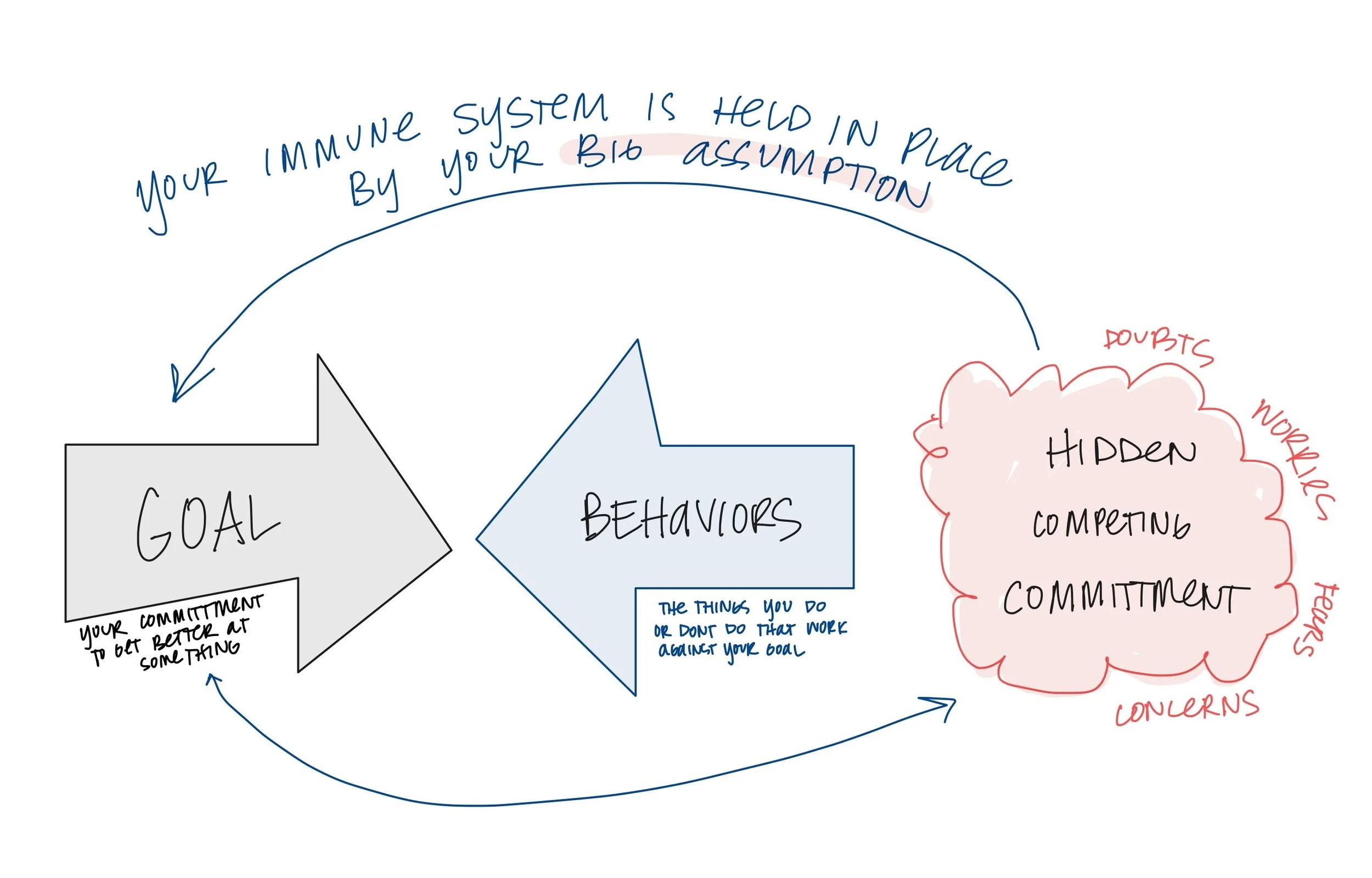
One foot on the gas (Column 1). One foot on the brake (Column 3). The car doesn't go anywhere — not because you're weak, but because you're driving with both feet.
Column 4: Your big assumption. This is the belief, held as truth, that makes the whole system make sense. It's the window through which you've been seeing the world — so thoroughly familiar that you don't notice it's there. Its like the water you are swimming in.
Big assumptions often sound like facts: If I ask for what I need, people will see me as high-maintenance. If I don't perform at the highest level, I'll lose people's respect. If I really go after what I want, I'll end up alone.
These beliefs were formed for real reasons, often early, often in circumstances where they were true or at least felt true. But the psychological immune system keeps running the old program even when the circumstances have changed.
The moment you can name a big assumption, something shifts. Not because naming it magically dissolves it, but because you can finally examine it. You can ask: Is this actually true? Is it always true? Has there ever been a moment when it wasn't?
That's the beginning of the work. Once you can see your big assumption, you can design safe tests to prove to your brain that it might not be true all the time. And that's how you create a little more adaptability and resilience. That's how you can make more progress on the things you care about.
PART FOUR: THE ENNEAGRAM CONNECTION
If you've been listening to this podcast for a while, you know I work with the Enneagram — and I want to make a connection here that I haven't made explicit before. (This is some behind-the-scenes coaching stuff...)
Your Enneagram type is, essentially, a map of your immune system.
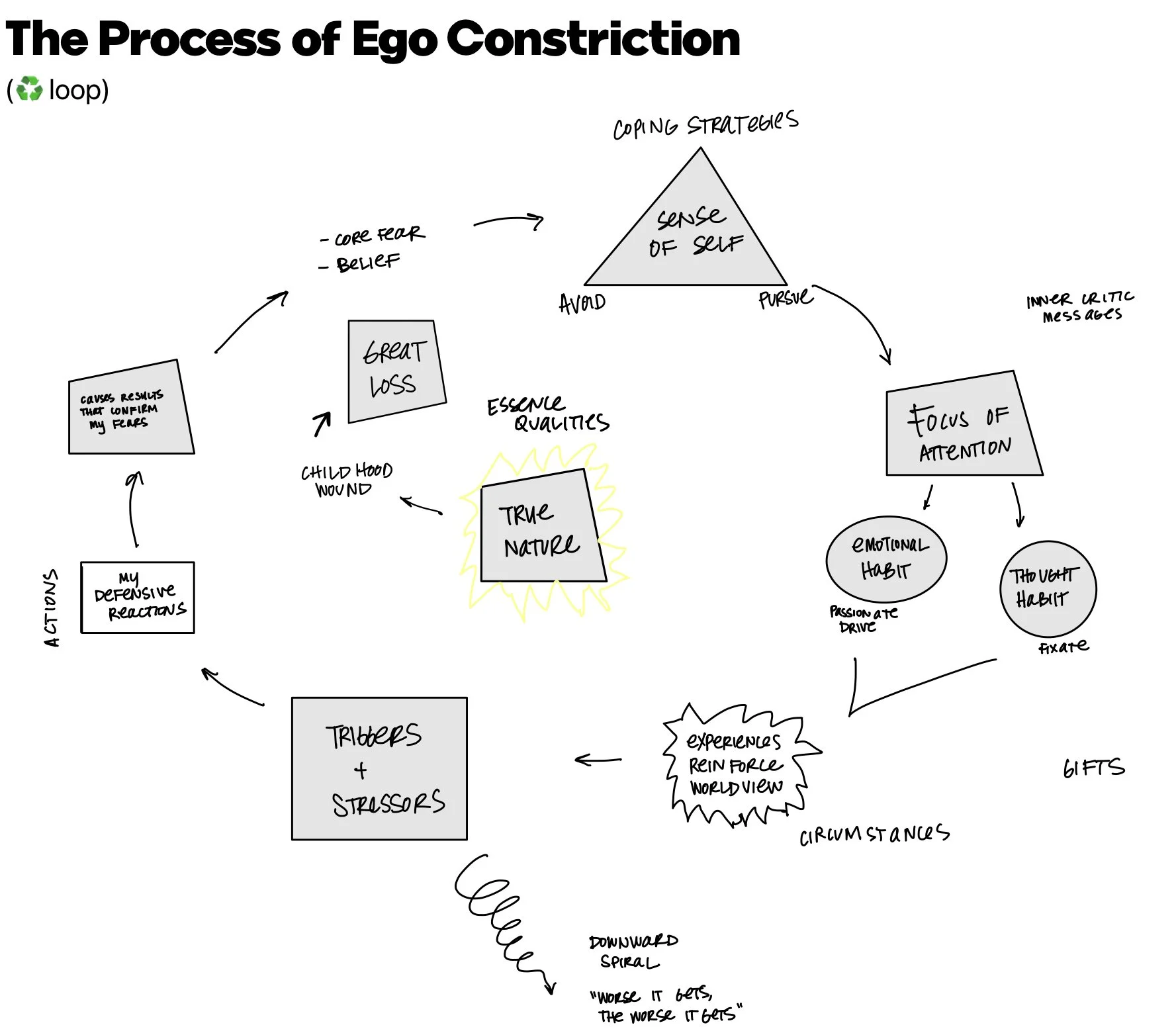
This is a diagram I use to describe the Enneagram personality style as a kind of reinforcing feedback look that keeps the ego structure in place.
The core fear at the center of each type (the wound that shaped the ego structure) is often the Big Assumption in Column 4. The coping strategies each type develops to manage that fear - the pursuing and avoiding, the defensive reactions, the focus of attention - those are Column 2 and Column 3. The whole ego constriction loop I often describe is the immunity to change, drawn in a different language.
A few examples of how this looks in practice:
A Ennea 3 is committed to slowing down and being more present. But their Column 3 hidden commitment is protecting their sense of worth through achievement. Their Big Assumption: without results, I have no value. Every time they try to slow down, the immune system fires: danger. So the calendar stays full. The hustle continues. And they wonder why they can't stop.
A Ennea 2 is committed to honoring their own needs. But their hidden commitment is remaining needed, because deep down, the Big Assumption is: if I stop giving, people will leave. So the boundaries don't hold. The self-care gets deprioritized. And they wonder why they can't stop people-pleasing.
A Ennea 6 wants to trust their own judgment and act with confidence. But their hidden commitment is staying safe by anticipating every possible threat. Big Assumption: the world is dangerous and I can't rely on my own discernment. So the decision sits. More input is gathered. More opinions are sought. And they wonder why they can't stop second-guessing.
You don't have to know your Enneagram type to do the immunity map. But if you do know your type (or even if you're just starting to get curious) the map gives you a way to see your type's operating system in action in your own specific life, in your own specific circumstances, right now. You can see how it is actually playing out.
And that is where change actually becomes possible.
PART FIVE: THIS ISN'T ABOUT WILLPOWER
I want to say this as plainly as I can, because I think it matters:
The reason you haven't changed the thing you've been trying to change is not that you're weak. It's not that you lack discipline. It's not that something is fundamentally broken in you.
The reason is that you are brilliantly, faithfully, intelligently protecting yourself from something that feels like real danger.
The behaviors in Column 2 (the ones that embarrass you, the ones you've vowed to change a hundred times) those behaviors are not evidence of your weakness. They are evidence of your immune system working exactly as designed.
The problem isn't the behavior. The problem is the assumption underneath it that says the danger is still real - that the threat is as large and permanent and certain as it was when you first learned to protect yourself from it.
My trainer on this process said something I keep coming back to: "The problem is not just something you are solving. The problem is also solving you."
Meaning: if you engage seriously with your own immunity - if you get curious about your hidden commitments and your big assumptions instead of just trying to bulldoze through them - you won't just solve the problem. The process of working through it will change who you are. You will not be the same person on the other side.
That's not incremental self-improvement, that's real transformation.
CLOSING
We've covered a lot of territory today, and I want to give you something concrete to walk away with.
If you're willing, try this: pick one area of your life where you've been trying to make a change that isn't sticking. Write it down as a commitment: I am committed to getting better at ___
Then, without explanation, write everything you're currently doing (or not doing) that works against it. Be honest. Be specific. Don't editorialize.
And then sit with this question: If I imagine actually doing the opposite of what's on that list, what feels most uncomfortable about that? What am I most afraid of losing?
That discomfort is pointing somewhere important. It's pointing to your immune system. And your immune system, as we talked about today, is not your enemy. It's the beginning of the map.
Here's what I want to offer you:
If you tried that exercise (even just the first two columns) and you felt that flicker of discomfort when you imagined doing the opposite, I want to help you take it further. Because the next part - finding the hidden commitment and the belief underneath it - is genuinely easier with another person in the room. That's not a flaw in you. None of us can see our own blind spots from inside them.
So I'm opening up free, one-on-one sessions where we'll sit down together (just the two of us) and map your immunity to change. Your real commitment, your real Column 2, and we'll start to uncover what's been quietly protecting you and why. No slides, no pitch, no funnel. Just 45 minutes of real work on something that actually matters to you.
This is open to the first 20 people who reach out. Partly because I want to actually be present for these conversations. And partly because this is exactly the kind of work I want to make available to you wherever you are right now, whether that's years away from ever working with a coach, or just curious what this process feels like.
If you want one of these spots, email me with the subject line "Immunity Map" and one or two sentences about what you're working on. I'll get back to you to find a time.
And if this episode landed for you, if you recognized yourself in any of this, I'd love to hear from you regardless. Send me a DM on Instagram, or leave a review. You can even leave me a voicemail with a question to answer in a future podcast episode on the website. Your feedback genuinely shapes what I make next.
Until then, keep upleveling.
Have you subscribed to the podcast?
Don’t miss a single episode. Choose your favorite podcast app below, then hit “Subscribe” or “Follow” to receive new episodes right when they are released.
(If you have another favorite app not listed, just search for “Upleveling Work” or “Michelle Kay Anderson” and it’ll come up.)